Sub plans
5 Things Every Math Sub Plan Needs (So You Can Actually Rest When You're Sick)
By Mr. Zeolla · 7th grade math and Algebra 1, New York
Every teacher knows the feeling. You wake up at 5:30 a.m. with a fever, and before you even reach for the thermometer you're thinking, "What are my kids going to do today?"
Then you're at the kitchen table, sick, writing directions for someone you've never met, for a math lesson they may not be able to teach.
I'm James Zeolla. I teach 7th grade math in New York, and I also support our Algebra 1 classes. I've written plenty of sub plans the hard way. Over time I figured out what a math sub plan actually needs so the day runs without me, and so I can stay in bed.
Here are the five things I put in every one.
1. A Lesson Plan Written for the Sub, Not for You
Your own lesson plans are full of shorthand only you understand. "Warm-up, then HW check, then 4.3 examples" means nothing to a guest teacher.
A good sub plan speaks directly to the sub:
- What to say when class starts
- Where the papers are and how to hand them out
- How much time each part should take
- What to do with students who finish early
- What to collect at the end
Write it as if the sub has never been in your building, because they might not have been. Short numbered steps beat paragraphs every time.
2. Work That Doesn't Require the Sub to Know Math
This is the big one. Your sub might be a retired English teacher, a college student, or a parent from the community. You can't count on them explaining how to distribute a negative or solve a two-step equation.
So pick work that students can do independently. Review is your friend here. A sick day is not the day to introduce a brand-new concept. Choose a skill your students have already seen and give them meaningful practice on it.
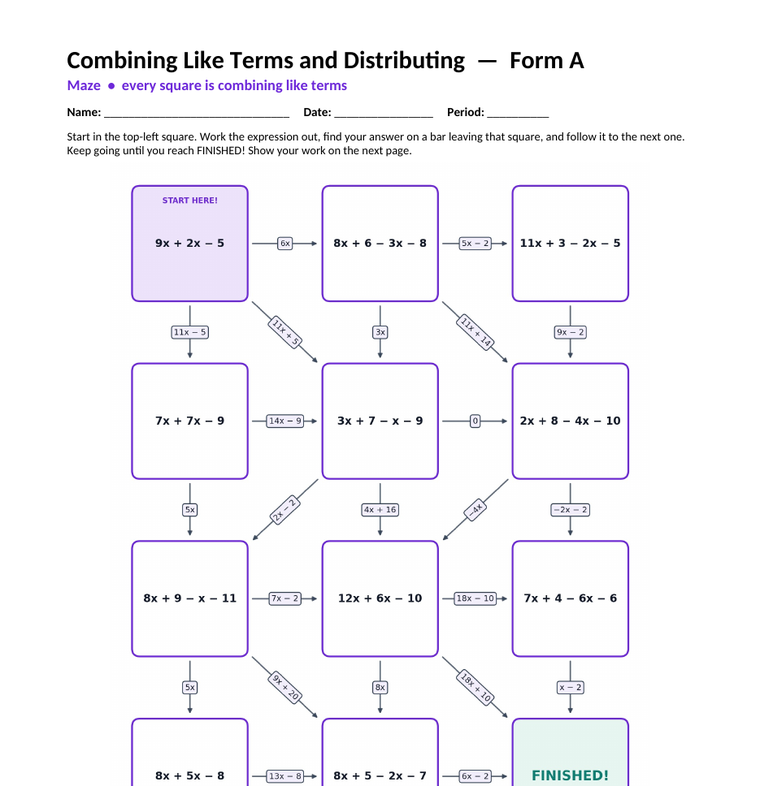
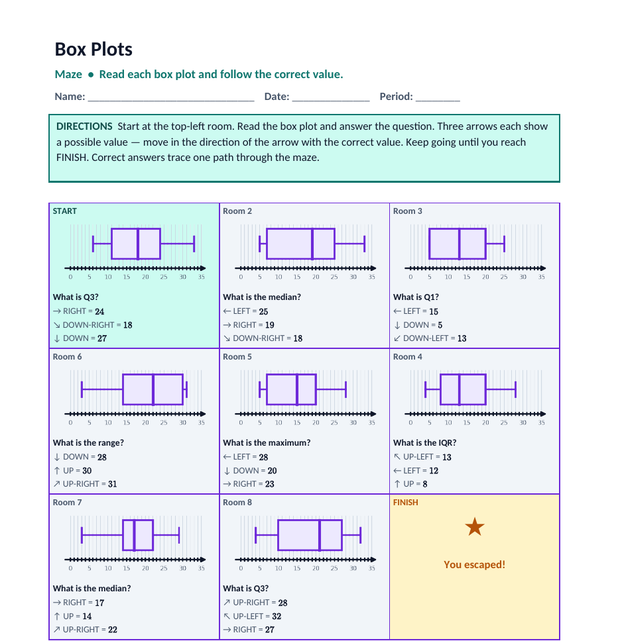
Self-checking formats help a lot. With a math maze, a wrong answer leads to a dead end, so students know right away that something went wrong, and the sub doesn't have to be the one to tell them.
3. No Prep and No Tech
When you're sick, you don't want to be emailing a slideshow to the front office or hoping the projector works. And a sub may not have a login for your computer or your online platform.
The safest sub plan is paper. Print-ready pages that can be copied in a few minutes (or that you keep pre-copied in a folder) mean the plan works no matter what. No passwords, no Wi-Fi problems, no "the video won't load."
My tip: keep one complete set, already copied, in a clearly labeled folder in your desk. Tell a teammate or your department chair where it is. Then on the morning you're sick, the only thing you have to do is send one text.
4. A Student Packet and an Answer Key
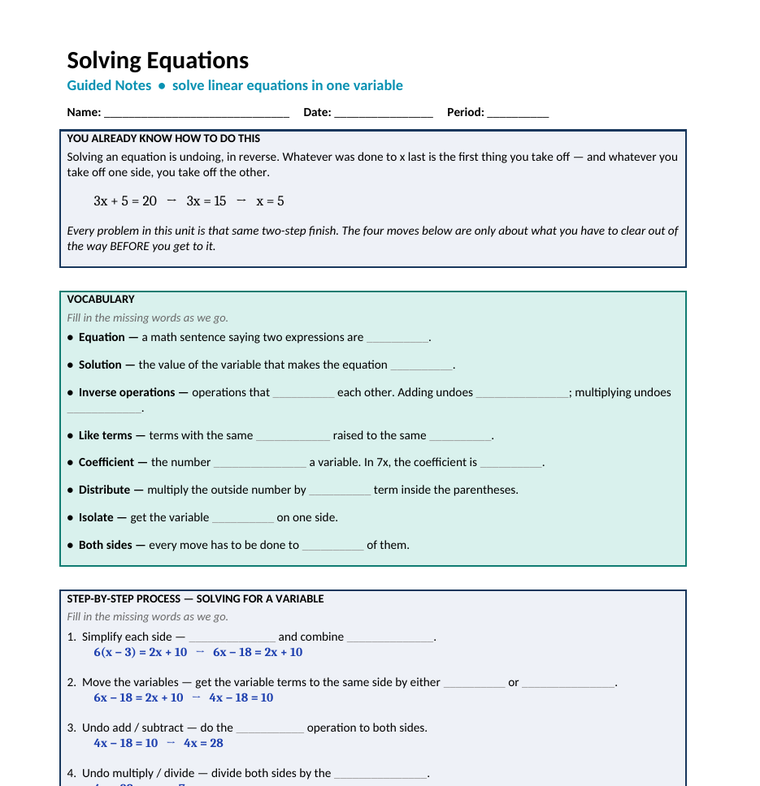
Give students a single packet with everything they need for the period. One packet is easier for a sub to hand out and easier for you to collect than three loose worksheets.
Then include the answer key, for two reasons:
- The sub can check work or answer the "Is this right?" question if they're comfortable.
- When you come back, you can grade quickly and see how the day went.
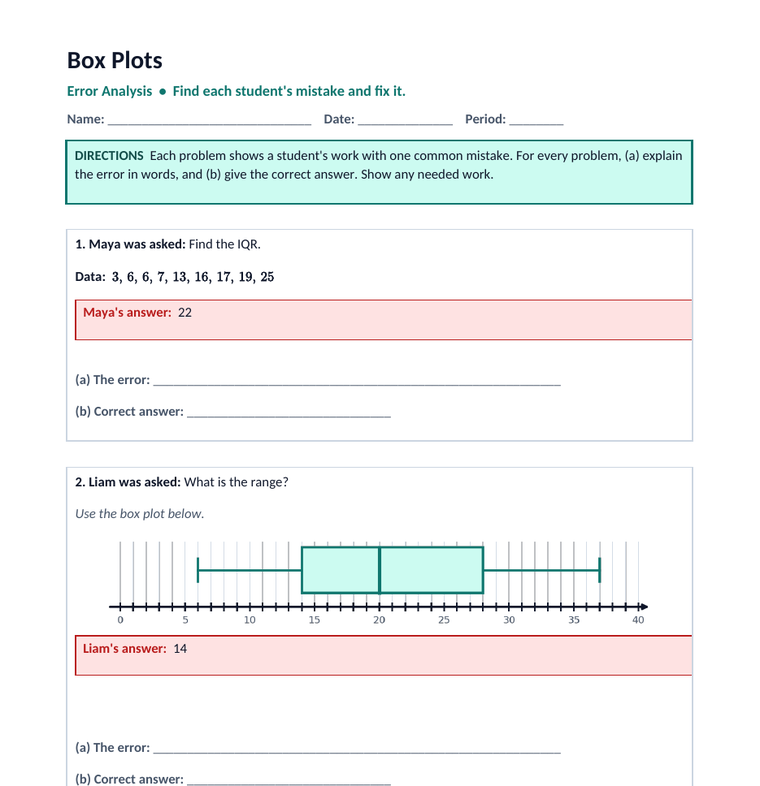
If the packet has a little variety, like some practice, a "find the mistake" error analysis problem, and something a bit more challenging at the end for fast finishers, you'll avoid the dreaded "I'm done, now what?" that leads to chaos.
5. A Note Back to You (Including Attendance)
The day isn't really over until you know what happened. Include a simple form for the sub to fill out:
- Attendance for each class
- Who was helpful
- Any problems or behavior issues
- How far each class got
- Anything you need to follow up on
This takes the sub five minutes and saves you from playing detective the next morning. It also makes the sub's job feel clearer, which means better days for everyone.
Putting It All Together
A math sub plan that really works has:
- A lesson plan written for the sub
- Work students can do without a math expert in the room
- No prep and no tech
- A student packet with an answer key
- A note back to you with attendance
Build one of these once, keep it in a folder, and the next time you wake up sick, you can actually rest.
Grab a Free Day 1 Sub Plan
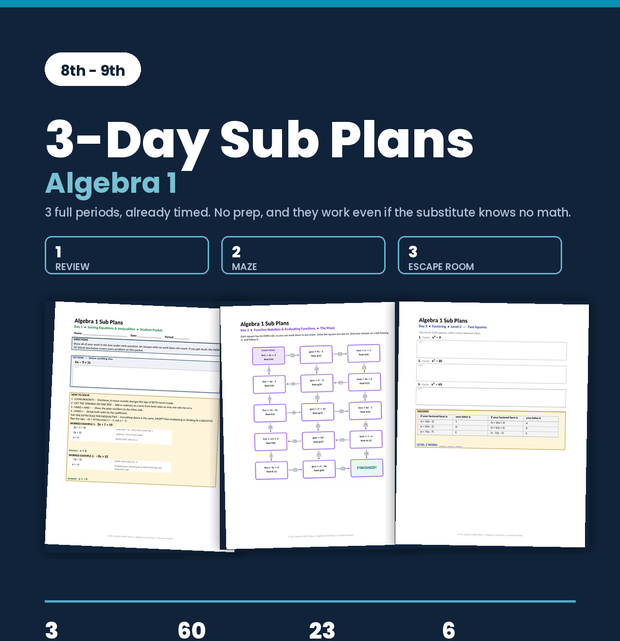
If you'd rather not build one from scratch, I've done it for you. My emergency sub plans include all five pieces: a lesson plan for the sub, a student packet, an answer key, and a note back to you with attendance. They're no prep and no tech, and they work even if your sub knows no math.
Head to mrzeollasmathshop.com, pick your grade (6th, 7th, 8th or Algebra 1), and I'll email you a FREE Day 1 emergency sub plan. Print it, put it in your sub folder, and you're covered.
Get yours here: mrzeollasmathshop.com
Feel better soon (or better yet, stay healthy).
Mr. Zeolla
Get a free Day 1 sub planPick Algebra 1, 8th, 7th or 6th grade and it lands in your inbox.
Get the sub dayPractice design
Why Self-Checking Math Activities Work (and How to Use Them)
By Mr. Zeolla · 7th grade math and Algebra 1, New York
Picture a typical practice day. You hand out a worksheet, students get to work, and you start circling the room. By the time you reach the back corner, one student has done all twenty problems with the same mistake. Another has stopped at number three because they aren't sure if they're on the right track.
That's the problem self-checking activities solve.
I'm James Zeolla. I teach 7th grade math in New York, and I also support our Algebra 1 classes. Self-checking activities have become the backbone of my practice days. Here's why they work, and how I actually use them.
What "Self-Checking" Means
A self-checking activity is built so that students find out whether they're right as they go, without waiting for the teacher.
The answer is built into the activity. If a student makes a mistake, the activity itself tells them something is off. They don't have to raise a hand and wait. They go back, look at their work, and fix it.
Three Self-Checking Formats I Use All the Time
### Math Mazes
In a self-checking maze, each correct answer tells students which path to take next. A wrong answer leads to a dead end, so students know right away that they need to go back and rework the problem.
Mazes are great for skill practice: solving equations, simplifying expressions, evaluating functions. Students like them because they feel like a puzzle, not a worksheet.
### Escape Rooms (No Locks Needed)
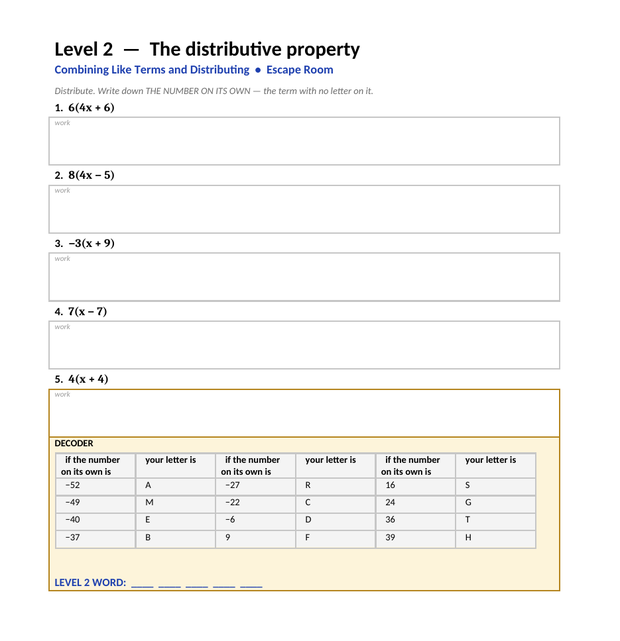
My escape rooms have three levels. Students work through a set of problems, and their answers unlock the next level. There are no physical locks or boxes to buy, so setup is just making copies.
Escape rooms work well for review because they build momentum. Groups want to "escape," so they check each other's work and talk through the math.
### Error Analysis ("Find the Mistake")
Error analysis flips the script. Instead of solving a problem, students look at a worked-out solution that contains a mistake, and their job is to find it and fix it.
This builds a skill that regular practice doesn't: checking work carefully. It's also low pressure, because students are critiquing someone else's mistake, not their own.
Why Immediate Feedback Matters
When a student practices a skill the wrong way twenty times, they get very good at doing it wrong. Then you have to undo it.
Self-checking activities catch the mistake on the first or second problem, not the twentieth. That changes the whole practice session:
- Students fix misconceptions early, while the lesson is still fresh.
- Students stay engaged because they know whether they're making progress.
- You spend less time answering "Is this right?" and more time helping the students who really need it.
- Struggling students get a signal to ask for help sooner instead of quietly falling behind.
It also builds independence. Over time, students learn to check their own work and go back without being told.
How to Use Them in Class
### As a Warm-Up
A short error analysis problem is one of my favorite ways to start class. Put one "find the mistake" problem on the board or on a half-sheet. Students settle in, think critically right away, and you get a quick read on who remembers yesterday's lesson.
### In Stations
Self-checking activities are perfect for stations because students can work without you standing there. Run a maze at one station, an error analysis page at another, and pull a small group to your table for reteaching. The independent stations keep running while you focus.
### For Early Finishers
Every class has students who finish early. Keep a stack of mazes or error analysis pages ready to go. Because they check themselves, early finishers can keep practicing productively instead of distracting their neighbors.
### On Review Days
Before a quiz or test, an escape room turns review into a challenge. Put students in small groups and let them work through the levels together. You'll hear real math conversations as they figure out why an answer didn't work. Follow up with a maze for individual practice, and you've got a full review day.
A Few Tips for Running Them Smoothly
- Require work to be shown. Self-checking makes guessing tempting. Ask students to show their work for every step so you can see their thinking.
- Talk about dead ends. Tell students up front that hitting a dead end is good information, not failure. It means they caught a mistake.
- Circulate with purpose. When you see a student stuck at the same spot twice, that's your cue to step in.
- Keep an answer key handy. Even self-checking activities go faster when you can glance at a key.
Try a Few for Free
If you want to see how self-checking activities work in your own classroom, I've put together a Free Resources page on my website with 11 free activities, grouped by grade: 5th, 6th, 7th, 8th and Algebra 1. Every one comes with an answer key.
Grab them here: mrzeollasmathshop.com/#/free
Try one this week as a warm-up or for early finishers, and see how your students respond.
Mr. Zeolla
Get a free Day 1 sub planPick Algebra 1, 8th, 7th or 6th grade and it lands in your inbox.
Get the sub day